
Efficiency Is More Than One Number
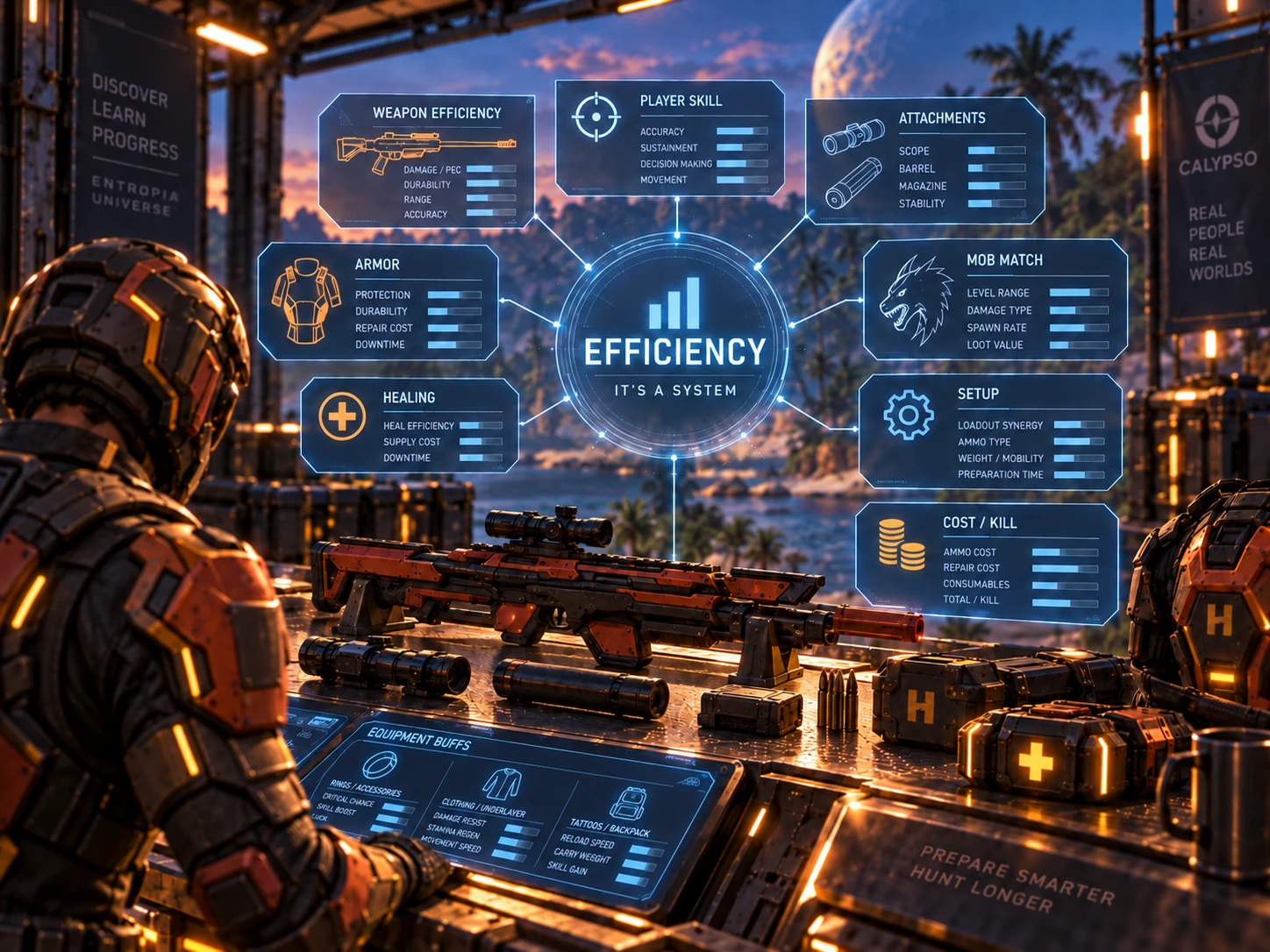
I wanted one number to tell me I was hunting efficiently
Even after I started paying attention to hunting costs, I still wanted a fairly convenient answer: one number that told me whether I was doing it well.
The weapon had one. Efficiency.
It was easy to give that stat more meaning than it could carry. If one weapon had higher Efficiency than another, much of the choice seemed settled. I might still look at price or damage, but the number felt like a summary of how well everything else was going to work.
It took me a while to separate the item's property from what happened when I used it.
MindArk describes Efficiency as a property of the item, independent of the avatar's skills. The displayed value isn't the expected return of the hunt. Equipping scopes, lasers and amplifiers can also change the value shown. Developer Notes #12.
Those notes say Weapon Efficiency contributes to the calculation of loot value, but accounts for no more than 7% of total loot value. Knowing that limit doesn't give me a return for each Efficiency value or a way to reconstruct a linear formula. Developer Notes #12.
The number matters. It just isn't measuring whether I've chosen a suitable mob, how often I'm healing or how much MU I paid for the equipment I'm using up.
An amp makes the distinction easier to see. I've seen a weapon showing 59 Efficiency, an amp around 85 and the equipped combination around 63.
The game isn't showing the sum or simply using the higher number. It's showing a combined value. That observation reminds me to look at the assembled setup. It doesn't reveal the internal formula used to calculate it.
Then there's the avatar using the equipment.
Animal Looter, Mutant Looter and Robot Looter are separate professions, distinct from the weapon's Efficiency. The notes that introduced them say developing the relevant Looter profession improves loot returns. They don't provide a formula for the result of my next run. Release Notes 15.16.0.
I can't treat every skill as another percentage to add to “my efficiency.” Folding HP, Evade, Dodge and the way I'm attacking into that same number wouldn't help me understand them either.
If I'm constantly healing, I need to look at how I'm handling the mob. If I want to compare attack spending, I need to look at the attacks. Calling all of it Efficiency leaves those questions unanswered.
In my own experience and in comparisons with other players, I've also noticed differences in stability. Around 50–60 Efficiency, I've seen more volatility. Around 70, returns felt more stable; at 80 or above, we observed more stability again.
Those ranges describe our observations. They aren't official thresholds that promise a different kind of hunt once you cross them. Those comparisons also don't isolate how much came from the weapon and how much came from everything else we were doing.
High Efficiency hasn't given me a reason to rule out dry periods.
And if getting that stat means using a Limited item bought with MU, each replacement brings back a cost. Whatever advantage I'm looking for has to be considered alongside that recurring spending. I can't judge the item as though I bought it at TT if I didn't.
That doesn't make the repairable alternative the automatic winner. It can tie up a lot of capital, although I still own the item afterward. If I stop using it, I can look for a buyer and recover some of that capital. The price may rise or fall; I won't know what I'll get back until it sells. A fully consumed Limited item has finished its usable life. To keep using that kind of equipment, I need another purchase, including its MU.
I'm comparing what I can use, afford and maintain, as well as what I might recover when I stop using it. Two item stats won't cover all of that.
Buffs and attachments give me more reasons to look beyond the weapon on its own. In practice, crit chance, crit damage and reload matter to me. I also pay attention to defensive effects, lifesteal and the equipment or consumables I'm using. Players with similar avatar development can have quite different hunts because of their gear.
Valuing an effect doesn't mean every ring, enhancer or pill that offers it is a good choice for me. What will it change in my case, and what will I spend to keep using it? If doing something faster means consuming more, that consumption belongs in the comparison.
Eventually, “How much Efficiency does it have?” wasn't enough. I wanted to know:
“What actually changes when I use this setup on this mob?”
I started looking at what each kill actually cost
That question takes me through the whole kill: the attacks before the big hit I remember, the time it took and everything I needed to finish.
DPP and DPS tell me different things about the attack. When comparing weapons, I use DPP in its usual community sense: damage per PEC of offensive spending. DPS puts damage against time. One helps me think about what I spend to deal damage; the other tells me how quickly I deal it.
Nominal DPP doesn't include armor or healing. It doesn't describe the whole encounter either. Regen can leave me needing to deal more damage, while overkill leaves excess damage on the final hit. If I stop attacking to heal, the weapon's DPS doesn't account for that pause.
In Analytics, I use Cost/Kill to compare offensive spending divided by the valid kills in the comparison. Attacks/Kill tells me how many attack attempts I'm using per kill. Both depend on having the kills, attacks and setup recorded correctly.
I need to read them together. Fewer attacks can still cost more if each attack is more expensive. Finishing sooner doesn't necessarily mean spending less.
A lower Cost/Kill helps me identify lower offensive spending per kill. To understand the whole economic cost, I still need to count armor, healing and the MU paid on Limited equipment, even though they're outside that metric.
Now I have a more useful comparison than “Which weapon is better?” What did this kill cost with this setup, against this mob and maturity? What changed from what I was doing before?
MindArk relates lower cost-to-kill to a greater proportion of Optimal Loot. That concerns the composition of the loot, rather than increasing its total value. Developer Notes #12.
It doesn't give me a recipe for getting the drop I want. It helps keep two questions separate: what I spent to kill the mob, and what dropped.
A better return on that run isn't enough to credit the weapon change. A worse return doesn't erase a reduction in cost that the records show, either. I can spend less on the attack and still finish that particular run with a worse result.
The comparison is still useful. I just have to be clear about which question it answered.
I wanted to understand my own activity: how many attacks I needed, what they cost, what I added to stay alive and how much equipment I was using up over time.
Then I could decide whether a change made sense for me. It might improve the attack but require a purchase that left me short of PED to continue. A smaller reduction in cost might be useful because I could sustain it without another recurring expense.
I didn't need one stat to make that decision for me. Efficiency was still on the weapon. I'd stopped expecting it to describe everything else.
There was still another part of the hunt that could tempt me into deciding too quickly. I could understand the cost, see a good drop and think I'd found my answer.
Knowing what I spent didn't mean I understood what had just dropped.