
Loot, Runs and Evidence
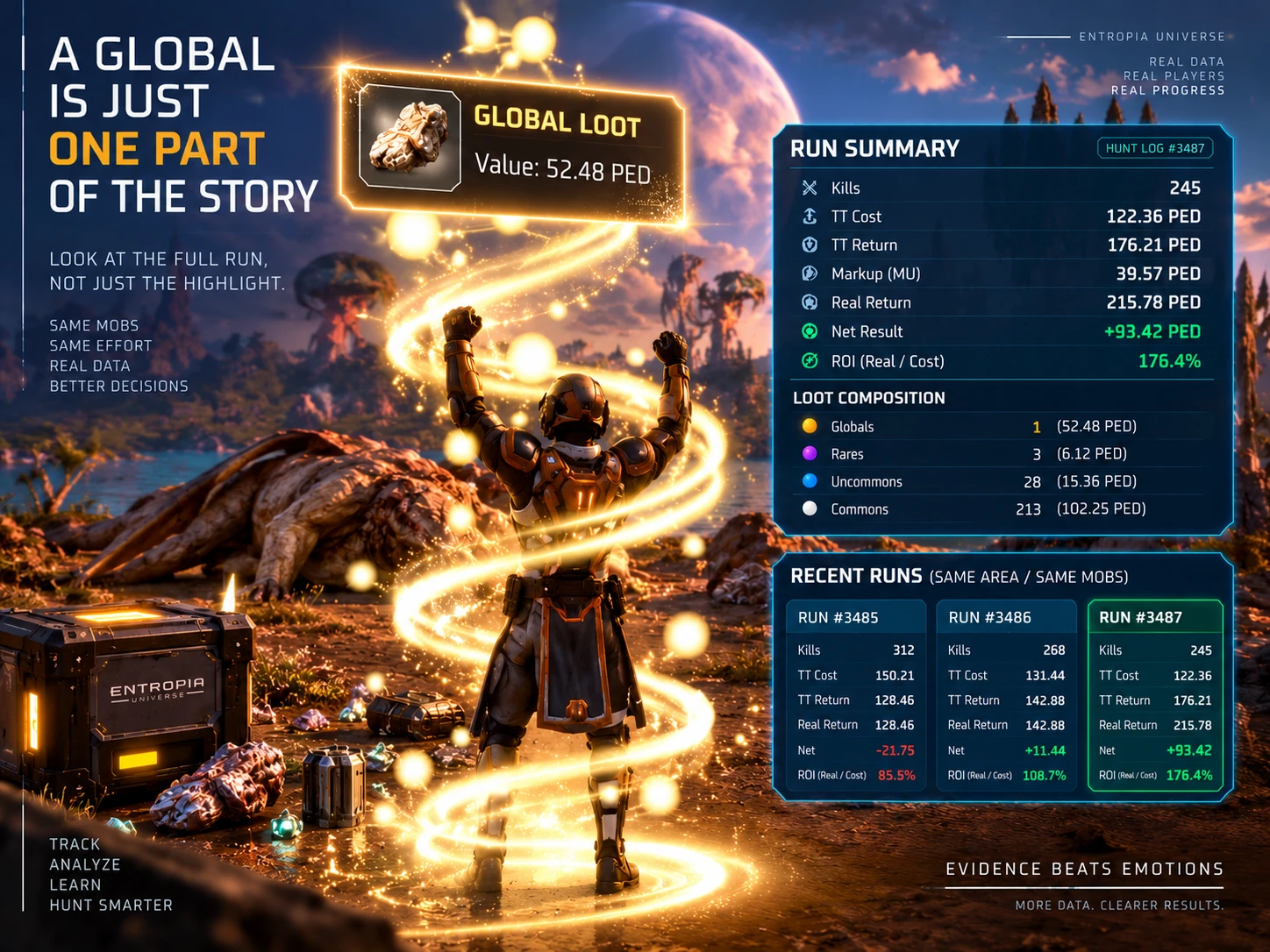
There was more to the loot than what had just dropped
You can check the setup, count the attacks and work out what each kill costs. Then something good drops, and for a moment the rest of the hunt hardly seems to matter.
The loot happened. What it doesn't tell you on its own is how the whole activity went.
When I look at loot, I need to separate its TT from what I might get by selling it. TT gives me a starting point. Markup brings in another question: what will someone pay for what I've got?
And what I've got matters just as much as the percentage.
A high MU on a tiny stack might add very few PED. A less impressive percentage on a material that dropped in greater quantity could contribute much more. Looking only at MU% leaves me without a clear idea of the value in the stack.
The reference price doesn't complete the sale, either. I might need to collect a larger amount, find a buyer or wait. If I need PED straight away, I may accept less than I'd hoped. Any selling costs come out of what I eventually receive too.
That's why “keep everything” and “never TT your loot” have never been useful rules for me. I want to know what that loot is worth to me, in that quantity, with the PED I need available.
Holding it can make sense. Holding it while I run out of bankroll has a consequence as well. The percentage I saw on the item can't make that decision for me.
Loot composition matters for the same reason. Similar TT totals can leave me with very different inventories: materials I can sell with MU, or drops for which I can't find demand. Turning one into usable PED may take much more work than the other.
From what I've observed, mobs have their own drops and their own range of loot. I've also seen setups that seem to produce much more shrapnel than others. I treat that as something worth comparing, rather than a formula for getting a particular item. A different way of killing the mob doesn't let me expect something outside its loot table.
I need to keep those distinctions when I look at the results in EntropiaControl. Real adds TT and the recorded MU contribution. Despite the name, it doesn't mean I've already sold everything for that amount.
Changing the MU reference can change the valuation without bringing me any closer to a buyer. That's different from receiving more PED from an actual sale.
Net is Real minus the recorded Cost. EntropiaControl uses ROI = Real / Cost × 100. At 100%, Real matched that Cost. Below 100%, it fell short; above 100%, it exceeded it. To read those figures properly, I need to know which costs were included and how the loot was valued. If expenses are missing, the figures don't describe the full economics of the hunt.
Comparisons need the same care. Looking at TT for one run and adding MU for another puts them on different terms. Changing the reference prices can also account for part of the difference between them.
I wanted a fuller answer than “I got something with good markup.” How much had I spent? What came back? How much of the value was still an estimate, and what was waiting to be sold?
Putting those pieces together could change how the activity looked. Even then, I still had to decide how much one run could really tell me.
A good run convinced me of one thing. A bad run convinced me of the opposite
Globals are easy to remember.
The ordinary kills before them aren't always so memorable. Neither is the spending that built up along the way. You can remember exactly what dropped and be much less clear about what it cost to get there.
At one point, I was down roughly 3,000 PED overall when a global of about 2,950 PED came along. There were other events worth hundreds of PED that reduced earlier losses too.
Those are easy experiences to recall. Telling only the global part changes the story, though.
That event sharply reduced much of the deficit I'd been seeing. It wasn't the same as making the entire amount on top of my costs. To understand the result, I needed to keep the spending and what had just come back in the same picture.
I also can't turn that experience into a reason to believe that continuing to shoot guarantees I'll recover my losses. What happened then doesn't tell me when another event will arrive, or whether it'll cover what I'm spending now.
I've had an exceptional drop from a small mob as well: a Scavenger Wolf gave me around 165–175 PED. I also witnessed another at roughly 450 PED.
Those events show me how far one drop can stand out from the rest. They don't promise another player the same result, or establish a universal minimum or maximum loot.
A kill gives me an event to look at. A run includes the whole stretch of activity I'm reviewing, including the unremarkable results. I can't use the memorable event in place of the run if I want to understand how I'm doing.
And one run has limits too. A good one tells me the result was good with those costs and that valuation. A bad one gives me a result to review. Neither establishes how the mob will behave every time I go back.
That affects how I read someone else's screenshot. It may be genuine and show an excellent run. It still doesn't tell me what they spent beforehand, what equipment they used, how they valued the loot or how many separate runs they had to compare.
It doesn't become my baseline, either. Their avatar, setup and ability to sustain the hunt may be quite different from mine.
I can create the same problem with my own results if I only keep the remarkable ones. Then an ordinary run gets compared with a collection of exceptions, and I wonder why the numbers don't look the way I remember.
The global still belongs in the result. Removing it for being exceptional would also change what happened. I want to see how much it contributed alongside everything else.
More kills give me more events to examine, but I need to know where those events came from.
A long run can show a lot of variation within one session. Separate runs let me look at what happens when I come back and do the activity again. Those are related questions, but they're not identical. Splitting a single session into several files doesn't create independent repetitions.
For a useful comparison, I need enough context: mob, maturity, setup, spending and how the results were recorded. Mixing different activities just to make the sample larger can leave me with more numbers and less useful evidence.
There's no magic kill count that lets me stop asking about those things.
I might see a result repeat and still need to check whether it holds across other comparable runs. I might have plenty of data but discover missing setup details, a change of maturity or a different MU valuation.
Saying “I still don't know” at that point doesn't dismiss the result. It keeps what happened separate from an explanation I can't yet support.
My avatar had changed. I was still making the old decisions
Having my own reference helps. It can also leave me relying on a reference that no longer describes what I'm doing.
“That mob is too expensive for me” may come from real experience. When was it, and what avatar and equipment did I have then?
If I've developed the offensive side, progressed in Evade or Dodge, gained HP or changed setups since then, I need another look. The mob's name can stay the same while the way I handle it changes.
The earlier records still have a purpose. They tell me what happened then. I can't treat them as a permanent verdict.
What interests me is which part changed. Less healing is something I can observe. Lower offensive cost per kill or a different attack count is another measurable difference. Better loot on the latest run, by itself, doesn't let me credit my avatar's development.
If I also changed the weapon, amp and maturity, I need those changes in the comparison. Otherwise “my avatar is more efficient now” can become an easy way to avoid examining everything else I did differently.
Comparing old and new results doesn't require pretending nothing changed. Seeing those changes helps me decide which comparisons are reasonable.
Some questions can be answered sooner than others. I can check whether a particular way of hunting needed less defensive spending. Showing that a mob now gives me better returns consistently would take different evidence. Avatar progression doesn't make every change in returns a demonstrated skill effect.
The price I get for the loot can change too. Finding a buyer at a different price affects the economic result even if the combat went much the same way. Some changes happen after the hunt.
I had to stop using “it's going better” as though it described one thing.
Am I spending less? Is the hunt more comfortable? Can I sustain more runs? Did I sell the loot at a better price? Or did a large event change the total this time?
Each answer tells me something different. Combining them without looking at where the difference came from puts me back in the position of expecting one number to explain everything.
To ask those questions later, I need more than an impression. Remembering that it used to go badly and went well this time leaves out the details that would help explain the change.
The next thing I had to learn was to stop expecting my memory to keep track of it all.