
Moving Beyond Memory
I changed too much to know what made the difference
After a bad run, it's tempting to change something before heading out again.
The weapon is an obvious candidate. So is the amp. Maybe another mob would be better, or a different maturity. If the hunt was uncomfortable, armor soon comes into the conversation too.
There may be a reason for every change. The difficulty comes afterward, when I want to know which one made a difference.
If the next run goes better, I can choose whichever explanation feels most convincing: the new weapon, the mob or the decision to go down a maturity. But I changed several things together. The result won't tell me how much each one contributed.
A worse run wouldn't answer that question either.
Comparing made me question that habit. Remembering which change had seemed most important wasn't enough. I needed to know what had actually changed between the activities.
Before comparing two setups, I need a question. Am I looking at offensive spending against the same mob and maturity? How much healing I need to sustain the hunt? Whether an affordable alternative puts less pressure on my bankroll?
Those are different comparisons. Finding out which of two runs ended with more loot won't settle them all.
Thinking in terms of Setup A and Setup B helps me keep the question clear, as long as I keep track of what's in each. If the weapon, amp, attachments and consumables all change, I'm comparing two complete setups. I can't give the weapon alone credit for the whole difference.
Keeping the rest similar where possible leaves fewer changes to explain. When I can't do that, I at least need a record of what changed.
None of this requires me to keep spending on a hunt I no longer want to sustain. I can stop with an incomplete answer. More evidence costs PED and time too.
I remembered the globals better than where my PED went
Remembering that I'd changed equipment wasn't the difficult part. Reconstructing everything around it was.
I'd remember the global. I might not remember the ordinary kills before it, the spending across the other runs or how often I'd gone back to the market for replacement equipment.
Limited items make that gap particularly clear. One purchase can seem like a small decision. Months later, I need more than the price of one item. How many did I use up, and how much MU did I pay as I replaced them?
Remembering the weapon's name doesn't bring back an accurate record of every purchase.
Loot has the same problem. I can remember that a material had “good MU” without remembering how much I collected, the valuation I used in the run or what I eventually sold it for. I can remember the item perfectly well and still misremember the economic result.
The ordinary runs count too. Keep only the exceptions, and I lose the part of the activity that helps me understand what I usually spend.
That's a reason to save a run that doesn't look remarkable. Later, it might be more useful for comparison than the screenshot that caught my attention.
The global still matters. I want it in the context of everything I actually did.
I needed something I could go back and check
The change was having somewhere to look when I started wondering.
“I think I spent less with the old weapon.”
“I seem to remember struggling more with this mob.”
“My PED haven't lasted as long since I changed setups.”
Without records, those thoughts can stay impressions. With saved runs, I can look for what I was doing before and compare it with what I'm doing now.
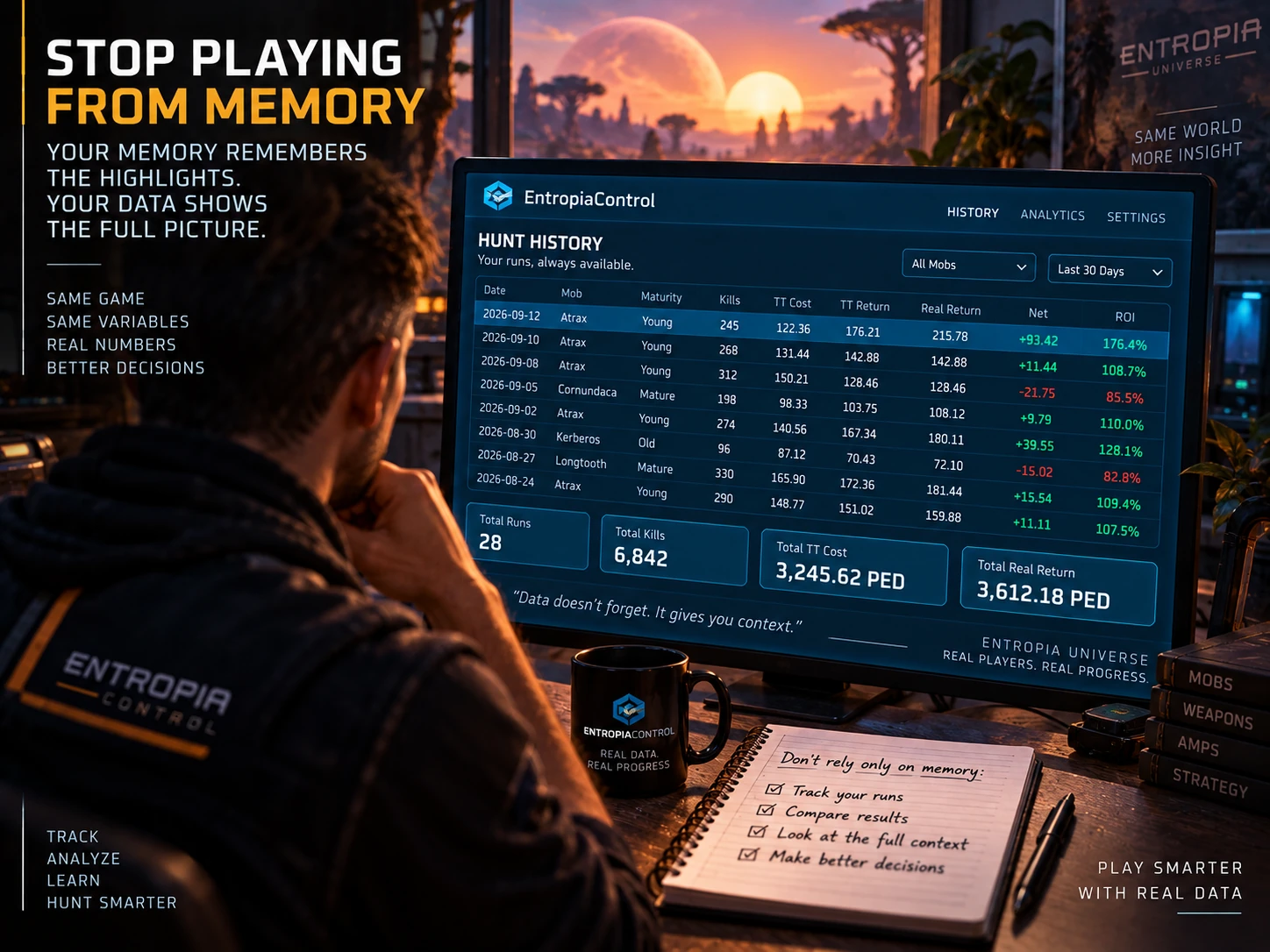
That's where EntropiaControl makes sense to me. It keeps a record of what happened so I can come back to it. In History, I can review saved runs, look at their results and compare records. I don't need every difference to become a theory about loot for that to be useful.
I still have to check what I'm looking at. Saving incomplete data doesn't fill in the gaps. If setup details, an expense or purchase information are missing, I need to acknowledge that. History can't reconstruct something I never kept.
That's also why I keep a distinction between the runs and the purchase and sale records I need separately. A saved hunt result doesn't establish how much markup I paid for every Limited item or the final selling price of each stack.
I can bring those pieces together to understand the activity. I shouldn't assume one screen contains all of them.
With that in mind, History gives me a reference I can revisit without having to recall every detail again. A run doesn't have to be perfect to be worth keeping. I do need to know what might limit its usefulness in a comparison.
Comparing my own runs gave me better questions
My baseline started making sense when it stopped being whatever I thought usually happened to me.
It's the group of results I use as a reference for a particular question. If I want to examine a mob and maturity with a certain setup, mixing in my entire history won't answer the same question.
I can keep a broad set of records and choose the ones that make sense for the comparison.
I also need to separate how much I did from what it cost to do it. Total spending might be higher because I killed more mobs. That total matters to the bankroll, but it doesn't establish that each kill became more expensive.
Per-kill measures help there, provided the data is attributed correctly. Cost/Kill and Attacks/Kill help me compare the attack. TT and the valuation including MU give me different ways to examine returns. Expenses outside the record still need to be considered when I look at the whole hunt.
Separating those questions lets me see differences that I used to roll into “this run was better.”
I might have spent less per kill while getting a lower return. Or the loot might have improved the final result while the attack became more expensive. Either way, both things happened. One doesn't cancel out the observation of the other.
I can also look at progression without using the size of the mob as the only measure. Coming back to a comparable activity lets me ask what my avatar needs to sustain it now, compared with before.
If I changed equipment too, I can't attribute every difference to the avatar. The records help me see the changes. I still have to interpret them.
That's what I want from Analytics: to understand what's being compared, what changed and how much evidence supports the reading. The metrics are more useful when I know which runs and circumstances they came from.
I want more than the final label when I read a Decision Engine diagnosis as well. State, Confidence, Why and Action help me follow the reasoning: what's being observed, how well it's supported, why it's being flagged and what to review.
I don't read Confidence as the probability that the next run will go well. An Action isn't an order that replaces what I know about my bankroll or the activity I can sustain.
If the comparison points to higher offensive spending per kill, I can review the setup and how I'm using it. If there isn't enough evidence for that comparison, demanding that the system choose won't produce a better answer.
A cost difference also doesn't prove what caused it. I need to look back at the circumstances, check what changed and see whether it repeats in a way that allows a useful comparison.
That was the value of keeping my runs. I could make the questions more precise, and the answers could be more precise too.
“I spent less in these records” is something I can check. “I'll always make more with this weapon” goes far beyond what those records can show.
The comparison doesn't create the savings. It shows me a difference in spending when that difference is actually in the data.
Sometimes, after all that measuring, I still don't know
Putting the records together doesn't always produce a clear conclusion.
There may be too few comparable runs. A global may account for a large part of the result. I may have changed too many things, or be missing what I need to separate equipment costs from the other spending.
The results may simply differ too much to support what I'm trying to say.
That doesn't make the work useless. It helps me distinguish what I know from what remains a possibility.
I can know what I spent without knowing why the loot behaved as it did. I can observe a better way of executing the hunt without evidence of a lasting improvement in returns. I can decide an activity doesn't fit my bankroll without proving the mob is bad for everyone.
I don't need to solve Entropia's algorithm to make that decision.
I need to understand what I can sustain, what I'm putting in and what my own results show. If something's missing, I can decide whether it's worth observing more, narrowing the comparison or leaving it there.
Observing more doesn't mean hunting indefinitely until the loot I want arrives. I can stop, review what I already have and return later with a clearer question.
Over time, that changed what I expected from my records. I wasn't looking for the location of the next global. I wanted to look back and know what I'd done: the equipment, the mob, the spending and the result.
From there, I could compare, recognize a change and decide what to check next. Sometimes that meant deciding not to spend any more for now.
At first, I wanted to know what to do. Then I wanted PED, and a way to sustain what I'd chosen. Later, I had to separate the weapon's stat, my avatar, the way I hunted, the loot and what I could actually conclude from it all.
Moving beyond memory didn't give every run an explanation. It meant I didn't have to invent one each time.
When the evidence still isn't enough, I can leave the answer where it belongs:
I don't know yet. But I know what I did, what it cost me and what I still need to check.